Home Project GH2006 Introduction Expo 2008 Dev Gallery Update 1 Update 2 Project Solar Ride BasicX Processor Contact |

Gooligan's Hooligans - 2nd Update
Program Update 2 - Version 1.2This page talks about the second major update for Gooligan's Hooligans home-made DIY custom built pinball machine. Version 1.0 of the game was essentially what was brought to the Pinball Expo in Chicago in October 2008. Version 1.1 was created in April of 2009 (see the link at left for Update 1). Version 1.2 was created in May of 2010 in advance of the Toronto Pinball and Gameroom Show held at the International Center in Toronto. This version of the game included minor physical improvements for extra fun and reliability and some software updates intended to be used at the show. Version 1.2 activities included on this page:
Reliability ChangesThe primary activity here was again to improve the reliability of the the Hoosegow subway ramp. Despite previous changes, the ball continued to frequently get hung up at the transition from one plastic piece to a metal piece, at a curve. I inserted some dense foam under the metal deflector plate in order to keep the plate in position and cause the ball to deflect and roll with some good velocity. Ideally the deflector plate would be made of heavier gauge steel, or the plastic piece molded with a better sloping profile in the first place. Two other things were also changed to help the ball roll along this under-playfield ramp. The metal ramp piece had one un-anchored mounting bracket. It was too close to the edge to use since it would interfere with the bracket that the playfield itself rests on. Some half-inch plywood was employed instead to anchor the bracket. This results in the metal ramp from being twisted and smooths out the transition from the plastic piece. It was also discovered that the playfield was sloped to the left a bit, even though the outer cabinet was level. The game was thus levelled to make the playfield itself level. This aided ball roll on the ramp and improved overall game play and balance. The ball now rolls freely on the subway ramp without hang up. A second issue was dealt with regarding the Warehouse VUK during multiball. If two or three balls landed in the VUK simultaneously, the kicker was not strong enough to always eject at least one ball. Retry logic usually would eventually result in the balls kicked out, but the delay could result in multiple retry cycles, obviously not too exciting to the player. Physically, the hole overhead "scoop" piece was re-profiled so as to impart a path on the kicked up balls more towards exiting. The profile now matches that of commercially manufactured VUK scoops or hoods. This helped a lot. On the software side of things, a new config parameter for coils was created, that being a "retry pulse time" for the coil. The pulse normally used for the VUK is very short. The retry pulse was made longer. The code had a hardcoded constant algorithm for increasing the pulse time on retries, but using a coil-specific value immediately should result in less retries required. Additionally, some new logic was applied to randomize the period between retries. The theory here is to vary the timing in order to create a Newton ball effect. In other words, the randomization will help create cases whereby there is separation in the VUK between the two balls when the coil fires. The energy of the first ball will be transferred to the second ball, propelling it out with force. The next retry then can kick the single ball remaining out. Testing shows that the Newton ball algorithm changes seems to work, with the balls being ejected fairly quickly. Of course ideally perhaps a stronger coil would be desired. However for our 25V system we don't have too many options and the current solution should suffice. Tommy Gun KnockerSince the initial release, there had been room for an extra coil to be added to the game. It was reserved for special effects but never implemented. The wire to the relay board had sat dormant in the body. It was decided to hook up a kickback kicker firing directly at the cabinet wall, in order to create a "tommy gun" staccato effect. An Alvin G kickback kicker was this wired up and placed to strike the side cabinet near the front right lower corner. Rules were added in the software to fire this new knocker when multiball jackpots were awarded, etc. In some cases a fixed number of knocks are generated while in some cases a random number within a range are used. The knocker sounds great like a gun staccato effect, and is very loud. At the show when it was used people from other games looked over - the desired result! Attract Mode UpdatesVersion 1.1 added the MP3 jukebox feature. Songs are added to a play list. When games are started the play list song can be used as background music for the game. Randomly selected tunes were also played occasionally in attract mode. However they were not part of the official play list, and were terminated when a game started. I didn't like that behavior (I wanted to continue listening to the same song in progress) so simply changed the logic so that the randomly chosen attract mode songs were placed on the official play list. Additionally a config option was added to limit the number of play list songs to be added to the list. That was intended for the show in case someone tried to add say 100 songs at a time. Additionally the concept of attract mode adveristing was added. Any configured display templates with name starting with "AttractMode" would be eligible to be displayed randomly in attract mode, with an associated image. For the show three ads were created. One was for advertising the latest Pinball Ad Catalog for sale and a couple for other purposes. Miscellaneous Software UpdatesFrom the Pinball Expo, feedback revealed that players didn't like having to go through a dialog at game start to set their name (even though it could be bypassed with just one flipper press). I therefore added a config option to bypass this dialog so the game starts like on any other machine. However, as I like to always play under my name, I set it up so that you can hold the left flipper while pressing the game start button in order to bring up the dialog to set your name. Show Results
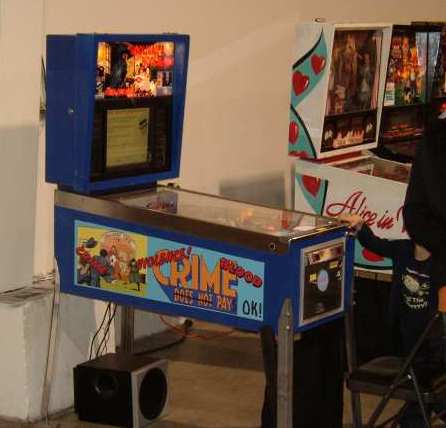
The game at the Toronto Pinball and Gameroom Show, beside the prototype Alice in Wonderland game created by John Popadiuk and Mike Hanley. The game was brought to the show following the above changes. It was setup and available for play for a total of about 15 hours over the two days of the show. Had I gotten there earlier each day the available time could have been as much as 18 hours. Over 100 games were played and the game held up well. Mostly nagging never-before-experienced ball hang ups kept the game from going without intervention. One ball hang up in the subway ramp occurred and the new mounting bracket point was adjusted. No further hang ups occurred (except when a lost rubber ring blocked the path!). Four balls got trapped in a rubber ring triangle - a problem never seen before. The rubber ring needs to be perhaps a bit smaller, or I need to double up on rings there. One ball inexplicably got trapped in the reset inline drop targets. I am not sure how this could happen. There is logic to prevent this from occurring. This problem has not been seen before. One ball was stuck by the microswitch on the upper ramp. I adjusted the ramp bracket to prevent further occurrrences. This also has never been seen before. A ball was not served once. This is a known problem that could have been circumvented by using a Help dialog option. The game requires an additional switch implemented in the ball trough. This problem can occur during multiball if two balls enter the trough simultaneously. It looks like one software thread got hung once. I haven't looked at the program log yet to see what happened there. Last updated: May 19, 2010 |